1. Introduction: Corporate Context and the Carbon Neutrality Imperative
The global transition toward net-zero industrial operations requires the mining and heavy materials sector to systematically evaluate and eliminate fossil fuel dependencies within raw material extraction. Nuh Çimento (Nuh Cement) and its wholly-owned subsidiary, Çimnak Co., have developed and executed a comprehensive engineering framework to achieve zero-emission scale in their heavy mining fleet.
Founded in 1979, Çimnak conducts the fundamental mining operations for the Nuh Group, managing the extraction and handling of 10 million tonnes per annum (Mta) of marl, limestone, and coal from the organization’s licensed quarries.
Because cement production is inherently carbon-intensive, the mitigation of peripheral emissions is an operational necessity. Nuh Cement’s preliminary sustainability efforts resulted in the commissioning of a waste heat recovery (WHR) plant producing 140 GWh of green electricity and a hydroelectric power plant producing 30 GWh of green electricity, effectively shifting almost 30 percent of the factory’s electricity consumption to green sources. Building upon this foundation, the company initiated an in-depth feasibility study in 2016 to target the high diesel consumption of its quarry loading shovels and excavators. The ensuing electrification program (2017–2026) established an economically viable model for heavy fleet conversion, operating strictly without external government subsidies or grants.
2. Overall Operational Efficiency: The Driving Force of Electrification
The fundamental rationale for replacing internal combustion engines with electric motors is the stark disparity in overall efficiency, which serves as the primary driving force behind the electrification of the mining fleet. Traditional diesel drivetrains exhibit an overall efficiency of merely 25 to 35 percent, with the majority of energy potential lost to heat and mechanical friction. Conversely, grid-connected electric motors operate at an overall energy efficiency of approximately 95 percent.
Operational data extracted from Nuh Cement’s heavy loading shovels provide empirical evidence of this efficiency gap. Historically, a conventional diesel-powered shovel consumed an average of 0.175 liters of diesel fuel to load one tonne of marl. When converted to electrical energy equivalence, this equates to an energy expenditure of 1.7 kWh per tonne of extracted material. In contrast, the retrofitted all-electric shovel requires only 0.45 kWh to perform the identical task. This physical superiority is absolute and remains independent of geographical location, operational scope, or volatile fuel costs.
Furthermore, the electric conversion process involves the total extraction of the diesel engine and its auxiliary components, including the radiator, turbocharger, air filters, and fuel pumps. This architectural simplification drastically reduces the maintenance workload, as the internal combustion engine and associated cooling systems represent the primary vectors for mechanical failure and time-consuming maintenance in quarry operations. The electric drivetrains operate without the need for engine oil, antifreeze, cooling water, or fuel filters. This yields a baseline energy efficiency multiplier of 3.8x (1.7/0.45). When this 95 percent operational efficiency is combined with regional energy costs, the electric fleet achieves a total operating cost advantage significantly greater than this baseline compared to the conventional diesel fleet.
3. Methodological Framework: Drive Technology Selection
Prior to the physical conversion of equipment, the engineering team evaluated multiple drivetrain architectures. Internal combustion engines operating on hydrogen fuel and proton exchange membrane (PEM) fuel cells were dismissed due to an absence of local refueling infrastructure and unfavorable price parity with diesel.
Similarly, in the initial phases, battery-electric solutions (such as lithium-ion configurations) were rejected for primary excavators due to high initial capital costs. Consequently, grid-connected electric conversion was determined to be the optimal technological pathway, uniquely satisfying the organization’s criteria for a short payback period and seamless integration into the daily extraction routine of approximately 10 Mta of raw material.
On the other hand, battery-electric architectures (specifically lithium iron phosphate configurations) proved to be the most suitable solution for dump trucks and wheel loaders.
4. The Electrification Journey (2017–2026)
- Phase I: Large Excavator Conversion and the Resurrection of Dead Iron (2017–2020) The initiative commenced with the electrification of large excavators, defined as machines with an operating weight exceeding 120 tonnes. The inaugural project targeted a discarded, 17-year-old Hitachi Ex-1200 loading shovel. Rather than procuring brand-new electric machinery, the engineering team executed a complete mechanical retrofit.
The diesel engine assembly was systematically replaced with a 500 kW electric motor, a 6.3/0.4 kV dry-type transformer, and a machine-mounted cable drum to manage 100 meters of power cable. This strategy fundamentally extended the service life of an obsolete asset—a practice referred to as the “resurrection of dead iron.” Following this success, the program retrofitted the much larger Hitachi Ex-1800 (180 t) and Ex-1900 (190 t) shovels. By late 2020, nearly 90 percent of total loading operations at the quarry were conducted by all-electric shovels.
- Phase II: Medium Excavators and Infrastructure Adaptations (2019–2021) Applying the experience gained from the 120t+ class, the engineering team expanded the program to medium-sized excavators (45–90 tonnes), specifically the Komatsu PC-300, PC-350, PC-450, and PC-550 series. This phase introduced distinct engineering challenges: the medium-voltage electrical components occupied considerable space in smaller engine compartments, and the rapid, frequent mobility required of medium excavators resulted in cable reeling difficulties.
Furthermore, transferring electrical current from a stationary lower frame to a rotating upper frame necessitated robust slip-ring designs to prevent hazardous electrical arcing. To sustain fleet mobility across the expansive limestone quarry, Nuh Cement engineered a modular power distribution skid termed the “e-House,” capable of simultaneously powering six excavators. The continuous operational lifespan of the fleet of 12 converted excavators and shovels eventually surpassed 67,000 working hours, proving that electric conversion architectures outlast standard internal combustion lifecycles and validating the economic viability of circular engineering.
- Phase III: Heavy Haulage and the “Gravity Hack” (2021–2024) Following the completion of loading machinery conversion in 2021, the focus shifted to the haulage fleet. The conversion of Euclid dumptrucks required the integration of high-density battery packs and inverter systems. The defining characteristic of this phase was the complete elimination of internal combustion engines and complex mechanical gearboxes.
This specific retrofit architecture unlocked what the engineering team termed the “gravity hack.” During loaded descent from the quarry face, gravity provides the motive force. The immense kinetic energy of the heavy dump truck is captured via regenerative braking to replenish the internal batteries.
Consequently, diesel consumption dropped from 40 liters per hour to an effective net electricity consumption of 0 kWh during downhill hauling cycles. The generated energy is subsequently used to propel the lighter, empty truck back up the grade. Furthermore, eliminating the mechanical gearbox entirely bypassed transmission failure—the primary vector for breakdowns in heavy hauling operations.
- Phase IV: Finalizing the Continuous Zero-Emission Ecosystem (2024–2026) The operational loop was closed in 2024 through the integration of 11 battery-electric wheel loaders, replacing 21 liters of diesel per hour with 40 kWh of With 12 excavators/shovels, 11 loaders, and 11 heavy trucks, the entire material handling sequence became electrically driven. Operating on a 24/7 continuous schedule, the combined fleet exceeded 100,000 proven working hours, moving 25 million tonnes of material via green energy and hauling 3.2 million tonnes seamlessly.
5. Impact Analysis: Diesel Displacement and Circular Economics
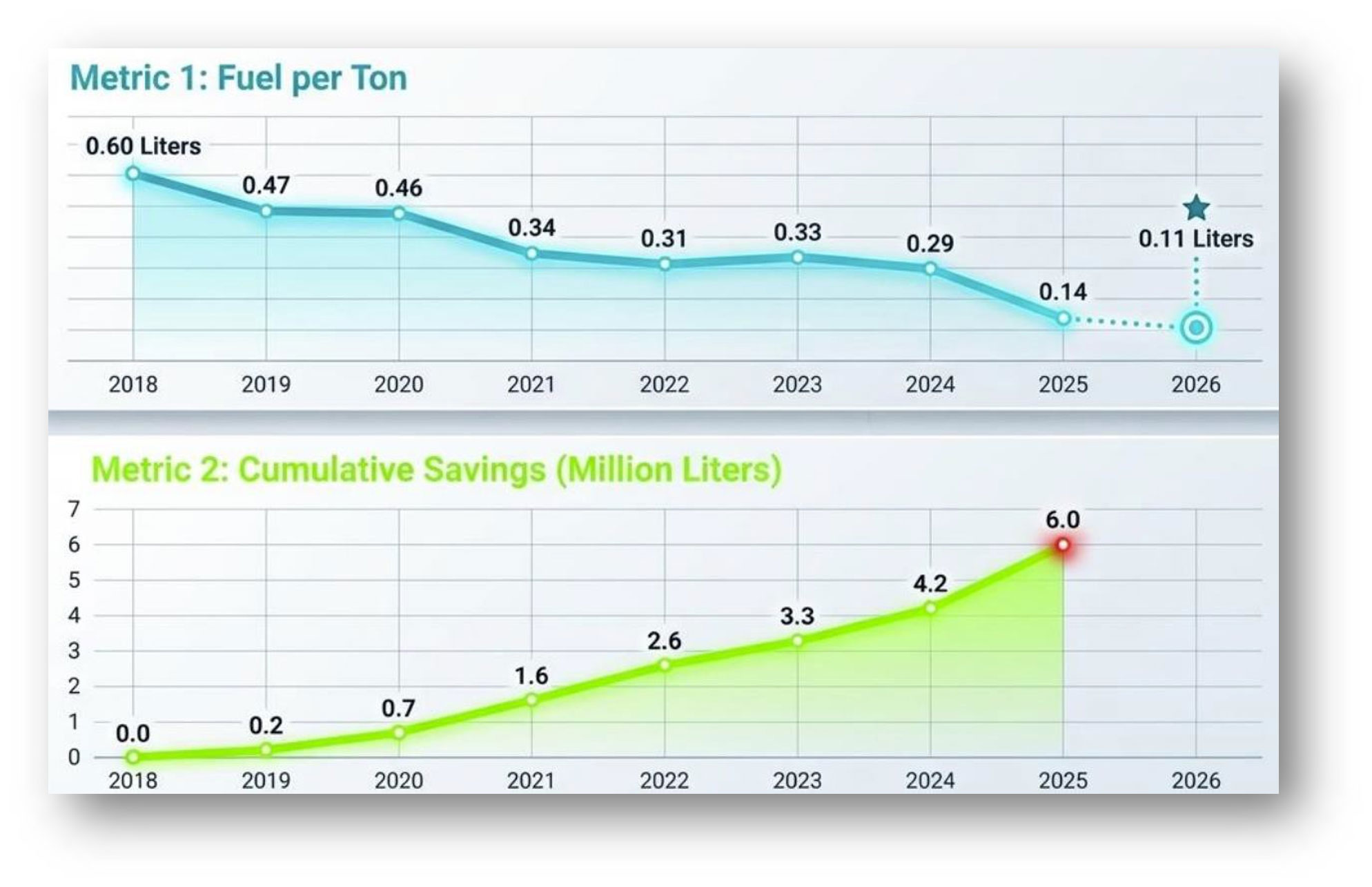
A dual-benefit model is apparent when evaluating capital expenditure and operational expenditure simultaneously. First, the systematic recovery of second-hand mining equipment severely minimized the capital intensity typically associated with heavy fleet upgrades. Second, the displacement of fossil fuels culminated in the permanent elimination of 6.0 million liters of diesel between 2018 and 2025.
Visual Data: Operational Impact and Fleet Metrics
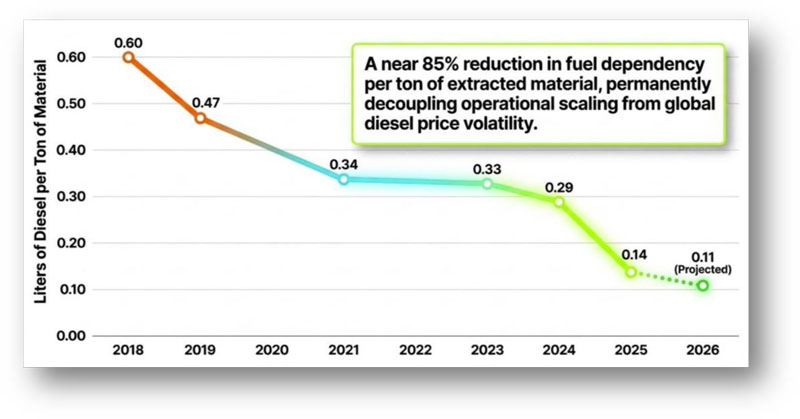
Chart 1: Crashing the Energy Cost per Ton (2018–2026) This data tracks the near 85% reduction in fuel dependency per ton of extracted material, permanently decoupling Nuh Cement’s operational scaling from global diesel price volatility.
6. What is Next: The Unexploited Potential of NIMO and Autonomous Driving
The electrification of the heavy mining fleet, while economically and environmentally successful, serves functionally as the prerequisite for a broader technological transition. Traditional internal combustion mechanics, reliant on analog inputs and complex mechanical gearboxes, are fundamentally incompatible with highly precise autonomous control. Conversely, electric drivetrains operate purely digitally.
Recognizing that digital drives enable autonomy, Nuh Cement has outlined its next developmental frontier: NIMO (Nuh Intelligent Mining Operations). Because the mechanical simplifications are already in place, real-life testing of tele-remote operation has been underway since February 2026. This system permits the long-distance remote operation of large loading shovels from centralized command centers. The development of local software for autonomous dump truck operations is scheduled for completion in the second half of 2026, after which real-world testing will begin.
The ultimate objective of NIMO is the realization of a fully autonomous quarry. This architecture will feature an AI-driven, quarry-to-raw-meal optimization system that directly interfaces with the zero-emission electric fleet to manage material flow. By establishing a highly reliable, 100,000-hour proven electric baseline through the revitalization of dead iron and calculated engineering, Nuh Cement is now uniquely positioned to implement total automation, representing the final frontier in zero-emission raw material extraction.