




Miguel Schloss President Surinvest Ltda.; member of Bretton Woods (World Bank- MF) Committee. Former Executive Director of Transparency International, and Director of Corporate and Budget Planning of World Bank.
Introduction
If it looks familiar, you’ve seen it in your dreams
If there are glaringly disruptive sectors, mining is certainly one of them. Extractive industries face growing nationalism and pressures to “control” such activities, which can undermine their potential competitiveness and productivity, and with it their contribution of surplus generation for economic development.
Among the disruptive forces needing special attention are: (i) the overwhelming impact on countries’ economic performance and creditworthiness; (ii) the associated implications on governance and corruption; and (iii) the growing environmental concerns to achieve carbon neutrality by mid-century, as per international agreements.
The Imperative of Social Acceptance and Economic Contribution
Dead fish go with the flow
More than most industries, mining relies on a high level of public consent since either the States or their citizenry tend to exercise a significant degree of control over access to, and exploitation of mineral resources.
Leading mining companies now accept that the industry’s continuing access to resources on viable terms – its “license to operate” – depend upon demonstrating that it has the capability to operate within transparent and sustainable development principles. To this end, the industry and the countries concerned need better governance structures to help manage resources generated by the sector.[1]
This will require a shift of traditional technocratic and State-driven approach to a more holistic and empirically anchored approach to problem-solving, and reducing discretionary powers in the public sector that generate conditions for corruption[2], through:
- Solid mining sector policies and strategies that provide incentives for investment and generation of a fair share of resources for the host countries, particularly through the adoption of legislation and regulations that are competitive internationally (including open, efficient and transparent access to mining properties)
- Establishment of a mining tax regime that is reliable, predictable and competitive
- Strengthening of government oversight institutions so that they can act on solid technical grounds, and independent vehicles of adjudication to assure fair treatment of all concerned.
- Buildup of a reliable system to technical data on the resource base of the countries concerned to facilitate generation of interest in further exploration and eventual production investments.
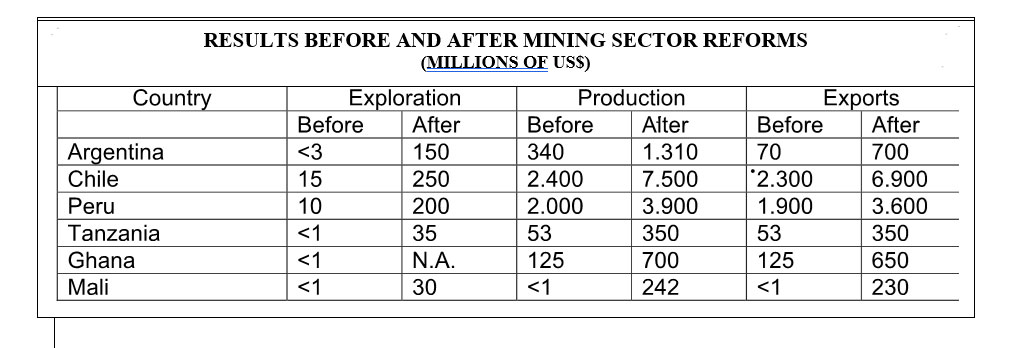
Countries that have adopted such policies have been rewarded with significant increases in foreign exchange earnings, fiscal revenues, investments and even levels of reserves resulting from increased exploration activities, as noted below, and consequent increased growth:
 Governance and corruption. Advertising helps, but doesn’t resolve issues
It is hardly a coincidence that countries with the greatest natural resources in general, and mining in particular, also are seen to have the highest levels of corruption and poor economic performance. There is an imperative of mining companies to achieve increased social acceptance and economic contribution – ultimately enhancing their “license to operate”. However, particularly disturbing is the high corruption associated with extractive industries – the economic bedrock for many developing countries. It should thus not be too surprising that mining has a poor connotation, and is seen as contributing to corruption. [3]
With the exception of Namibia, Botswana and Chile, all other developing countries whose mining sector exceeds 5% of their GDP are rated in the lower 50% of World Bank Institute governance indexes in such as control of corruption (or for that matter Transparency International’s corruption perception index), as can be seen below:
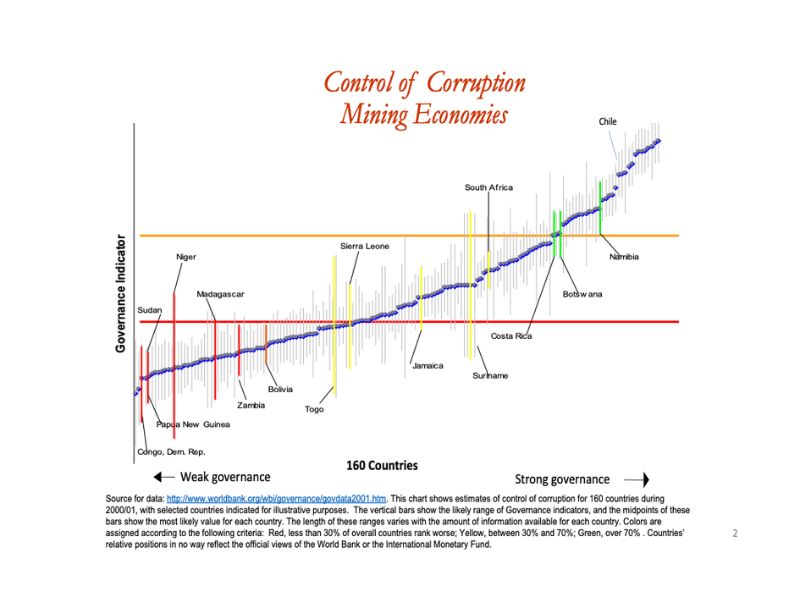
Most international surveys suggest that international companies, particularly mining enterprises, are seen as having “too much power”. The key challenge to the extractive industry in the 21st century is thus to operate in an increasingly globalized, competitive, demanding and integrated world.
The era of enclave projects and sheltered existence has come to an end, and their activities are subject to ever-closer scrutiny. Inevitably, host countries’ corruption and poor development performance impairs the industry’s reputation, increases shareholder risks, impedes efficient use of resources, and can even lead to social unrest.
All too often, the state and institutions managing these resources are unaccountable to the ordinary citizens and become vehicles for embezzlement, fraud, misappropriation and corruption. As a result, more than most industries, mining relies on a high level of public consent to be able to sustain its activities.
Energy, Mining and Climate Change: Quo Vadis?
If you don’t like change, you will like obsolescence a lot less
Mining is both one of the most energy-intensive industry and a major source of raw materials for other industries, including renewable energy technologies. Both factors need to be reconciled more effectively to assure a viable long-term future in the mining sector.
Luckily, mining (particularly copper), while being both energy and carbon emitting intensive, is as well a key input for renewable power generation. With proper policies could become an integral part of the emerging clean tech economy and a source of growth in years to come.
Sustainable strategies across the mineral value chain may have to be instituted to assist governments in building robust policy and regulatory frameworks that promote climate-smart mining and an enabling environment for private capital to do its part [4] particularly to:
- Underpin integration of renewable energy into mining operations, given the mining sector’s significant share of global energy use and that mining operations in remote areas often rely on diesel or coal
- Support the strategic use of geological data for a better understanding of “strategic mineral” endowments
- Recycle of minerals: supporting countries to take a circular economy approach and reuse minerals in a way that respects the environment.[5]
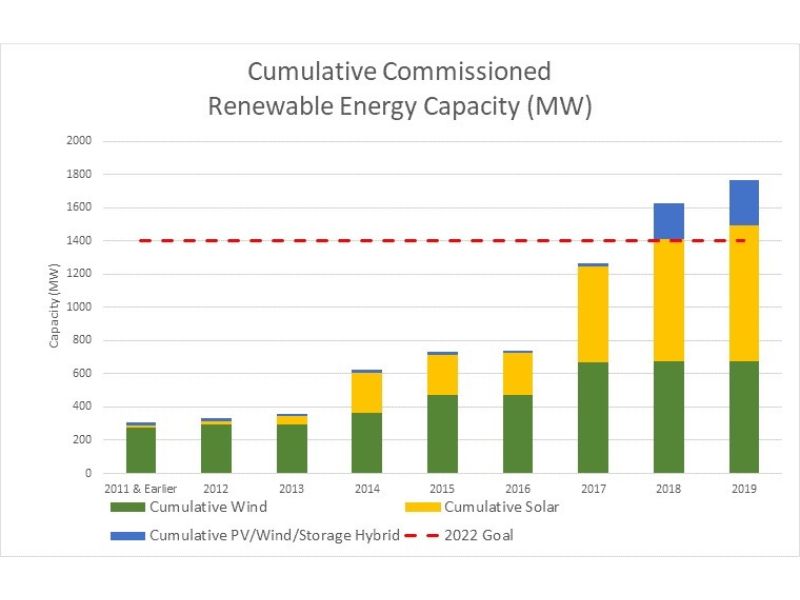
The mining sector is already availing itself of more recent opportunities for renewables use in mining operations, outpacing growth compared in many other sectors, though admittedly from a low base, with cumulative commissioned capacity surpassing 1.7 GW:
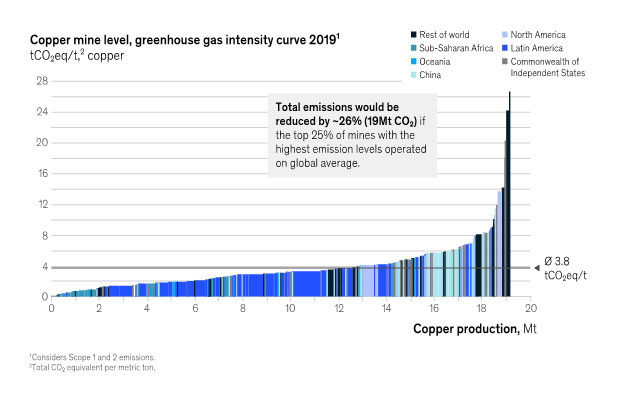
 However, the emissions intensity varies widely across mines: for example, within copper, we see a twentyfold spread among the emissions intensity of mines, as can be seen below:
The transition from fossil fuels to low-carbon energy sources will depend on critical minerals. Their consumption could increase sixfold by 2050, according to one scenario [6] by the International Energy Agency. In that world, the trade [7]in energy-related resources will consist largely of critical minerals rather than oil and natural gas.
The Challenges of the Way Forward.
Generate enabling conditions, capacity, not dependency
The challenge is to open to policies that respond to growing societal demands. This requires a technical as much as a more people-centered approach, to avoid Governments or private companies “capturing” emerging opportunities for those in power.
This will require more effective incentives (not more bureaucratic and expensive regulations), through proper taxation and pricing arrangements whereby Polluter Pay arrangements enables them to defray externality costs they generate and respond more effectively to societal demands.[8]
- [1] Instituto de Gobierno y Gestión Pública – Universidad de San Martin USMP (Lima, Perú) Dec. 2025 – “Experiencias Internacionales para Fortalecer la Gobernabilidad (International Experiences for Strengthening Governance)” ISSN 2414-4991 (M. Schloss)
- [2] Academic Research and Publishing Group, May 2021: “Recasting Governance for Challenging Times” ; Global Journal of Management and Business Research, August 2021 (M. Schloss)
- [3] El Mercurio (Santiago, Chile) May 16, 2018 – M. Schloss. “Política minera para impacto económico”; Capital Business Journal (Santiago, Chile) Feb. 2024 – “Política minera; del subsuelo al desarrollo económico”; Abbreviated version published in Pulso – Feb 14, 2018 (M. Schloss)
- [4] Capital Business Journal (Santiago, Chile) Feb. 2018-25 – “Política minera; del subsuelo al desarrollo económico” . Abbreviated version published in Pulso – Feb 14, 2018
- [5] Global Journal of Science Frontier Research; 2025 M Schloss “Walking on a Knife’s Edge to Reconcile Energy & Environment”
- [6] International Energy Agency: World Energy Outlook 2021-2025
- [7] https://twitter.com/fbirol/status/1448136581034827787
- [8] Academia Environmental Sciences and Sustainability; 2026 “Strengthening the Polluter Pays Principle”.
