.png)
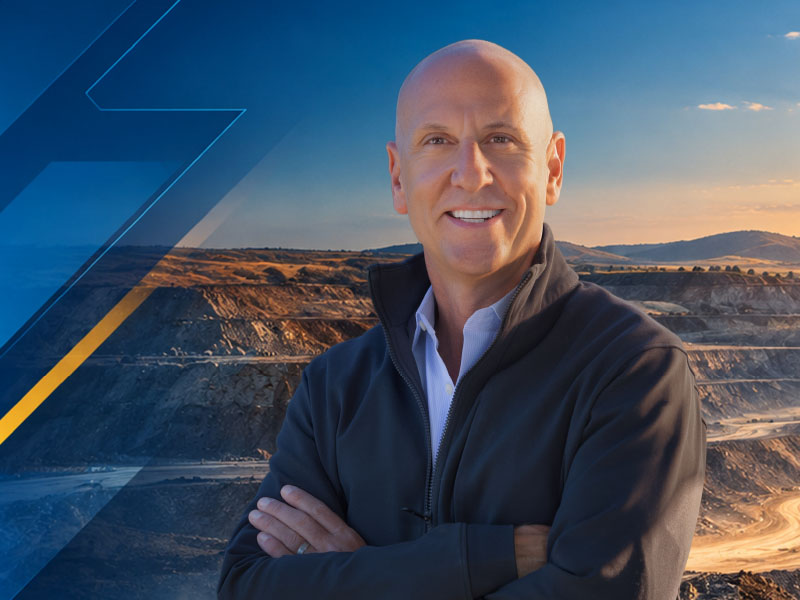
For Strata Worldwide, the story of mine safety began with a simple but difficult question: how can people communicate, locate one another and access critical information in an environment where conventional technology has limitations?
The question became particularly urgent following the 2006 Sago Mine disaster and the introduction of the U.S. MINER Act, which placed new emphasis on underground communications, tracking and emergency preparedness. It was against this backdrop that Strata began developing what would become its electronic safety and communications business. Today, that work has expanded into a connected technology ecosystem designed to help mines communicate, track people and equipment, monitor conditions and increasingly turn operational data into actionable safety intelligence.
At the center of this journey is Mike Berube, President and CEO of Strata Worldwide. Prior to joining Strata, Berube was an entrepreneur and technology executive working in the defense sector, where he specialized in communications and networking technologies. Around 2008, his engineering team began working with Strata to develop a next-generation wireless communications and tracking platform designed specifically for underground mining. That collaboration resulted in CommTrac®, which was completed in 2010. Berube joined Strata that same year, bringing communications expertise that would help shape the company's electronic safety technology roadmap for the next decade and beyond.
From a Mining Challenge to a Wireless Breakthrough
When the project began, the engineering team came from the defense communications industry and possessed extensive expertise in wireless communications, networking and mission-critical systems. What they lacked was mining experience. Through close collaboration, Strata contributed deep underground mining knowledge while the engineering team applied advanced communications technologies to solve unique mining challenges. The result was CommTrac, a purpose-built wireless communications and tracking platform designed specifically for underground operations.
Battery-powered and operating below 24 volts, CommTrac was designed for simplicity. It did not require a certified electrician for installation, and two people could install an entire mine in just a few days. Competing systems would require weeks and substantially more infrastructure.
“We wanted to provide mission-critical and mandated technologies that are truly differentiated,” Berube says.
The system ultimately became active in approximately 120 mines globally and remains one of Strata's foundational technologies. More importantly, its development established a principle that continues to shape the company: technology should solve a critical problem while remaining easy to install, maintain and use.
Building Technology as Interoperable Blocks
Strata's work initially grew from the needs of U.S. underground coal mines, where the MINER Act created a substantial market for electronic safety technology. The company subsequently expanded into underground hard-rock mining and tunneling, taking its communications expertise into a much broader range of environments.
Rather than building its business around a single technology, Strata developed a portfolio of systems that could work together. Communications, personnel tracking, asset tracking, atmospheric monitoring and high-speed data can be combined according to the requirements of a particular mine. A customer can, for example, combine BLE (Bluetooth®) tracking with voice communication or text messaging, while atmospheric monitoring can be incorporated into the same overall network.
“We really believe that when you look at the full array of technologies we have to offer, we have the broadest breadth of technologies that can be put together in a fashion that meets the customer's specific application,” Berube explains.
This building-block philosophy also helps mines deal with existing infrastructure. Many operations have miles of legacy copper or leaky-feeder cable that cannot simply be discarded. Strata's DigitalBRIDGE® technology allows mines to retain that infrastructure while introducing digital capabilities such as high-speed data, Wi-Fi, cameras and Power-over-Ethernet. DigitalBRIDGE Plus+® takes the concept further, delivering digital push-to-talk communications alongside Wi-Fi, VoIP phones, cameras and atmospheric monitoring over leaky-feeder coax.
As mining becomes increasingly automated, the network itself becomes more important. Autonomous vehicles require reliable, high-bandwidth connectivity, and underground LTE has emerged as an important technology for these applications. Yet deploying LTE globally is not always straightforward. Mining companies operating across different countries cannot simply replicate one system everywhere because wireless spectrum requirements vary by jurisdiction.
To address this challenge, Strata has worked closely with Australian technology company Vernetzen to develop advanced networking solutions that can be deployed globally without many of the constraints associated with LTE systems. The technology is designed to leverage leaky feeder cable to radiate high-bandwidth Wi-Fi linearly throughout the underground operations. The technology addresses mobility and handover challenges while delivering the throughput and bandwidth required for increasingly connected and autonomous mines.
When Connectivity Becomes Intelligence
Strata's technology journey has moved beyond simply establishing communications. The company increasingly sees the data generated by its systems as an important part of the safety equation. That realization led to SafeSITE™, a graphical user interface and database through which information from Strata electronic technologies can be brought together. Connectivity, proximity detection, collision avoidance and AI cameras can all contribute information to the platform. The system is also becoming more open, allowing mines to access data through cloud-based tools and create customized reports.
“The real value isn't the individual hardware components or embedded software,” Berube says. “It's the ability to transform data into actionable information that improves safety and operational performance. When all of these technologies work together, the result becomes greater than the sum of its parts.”
Through SafeSITE, information from communications networks, tracking systems, proximity detection technologies, collision avoidance systems and AI-enabled cameras can be combined into a unified operating environment. The objective is not simply to collect data, but to provide information when it is needed most and generate insights that help improve both safety and productivity.
Consider a mine where workers and vehicles repeatedly converge at a particular intersection. Tracking data can reveal congestion, near misses and unsafe operating patterns. The information can then be used to implement practical controls and improve workflows. The objective is not simply to gather more information, but to create actionable safety intelligence that helps organizations make better decisions and continuously improve operations.
Extending Safety into the Rescue Environment
Strata's emphasis on practical problem-solving is also visible in the new wearable alarm device, PAL+ (Proximity. Alerting. Location). This new capability is being launched in South Africa in 2026. The technology addresses one of the most difficult scenarios underground: locating a miner who may be trapped beneath rock or rubble following a roof fall or rib roll.
Strata already provides last-known-location capabilities, where the mine’s tracking system enables the fast identification of each miner’s last known location underground. The PAL+, is worn by the miner and works with Strata’s proximity detection systems and communication networks. If a miner becomes buried under rubble, a locating unit can be deployed to receive signals from the PAL+ and identify the individual's position. The technology can operate through CommTrac, Wi-Fi or BLE, giving rescue teams multiple options depending on the network available at the mine.
Strata is also looking beyond the largest and most technologically advanced operations. A patent-pending wireless networking technology planned for 2027 is intended to provide a lighter-weight approach to rapidly deploying underground communications infrastructure. The target is mines that may not have extensive fiber infrastructure or the resources to undertake lengthy network installations. Strata sees an opportunity to give these mines access to digital connectivity more quickly, with Latin America and the United States among the initial target markets. The goal is consistent with the company's original approach: reduce infrastructure requirements while making advanced technology practical.
StrataConnect as the Foundation
All of these capabilities ultimately connect back to StrataConnect, which Berube describes as the foundation for the company's communications, high-speed networking, tracking and data technologies.
Communications are mission-critical because every mine needs a dependable way to communicate. Once that network is established, additional technologies, including refuge chambers, collision avoidance systems, AI cameras, tracking and monitoring, can be integrated into a broader electronic safety ecosystem.
Strata's philosophy is not to simply rebrand third-party products and sell them as a portfolio. The company engineers technologies to work together, allowing customers to expand their systems as requirements evolve. The underlying principles remain consistent: make technology easier to install, make it safer, reduce total cost of ownership and ensure that each capability builds upon the next. “Everything we do is focused on helping customers create a safer, smarter and more connected operation,” Berube concludes.
Mike Berube, President & CEO
strataworldwide.com
“The future of mine safety isn't just connectivity. It's turning connectivity into intelligence that helps people work safer and operations perform better.”
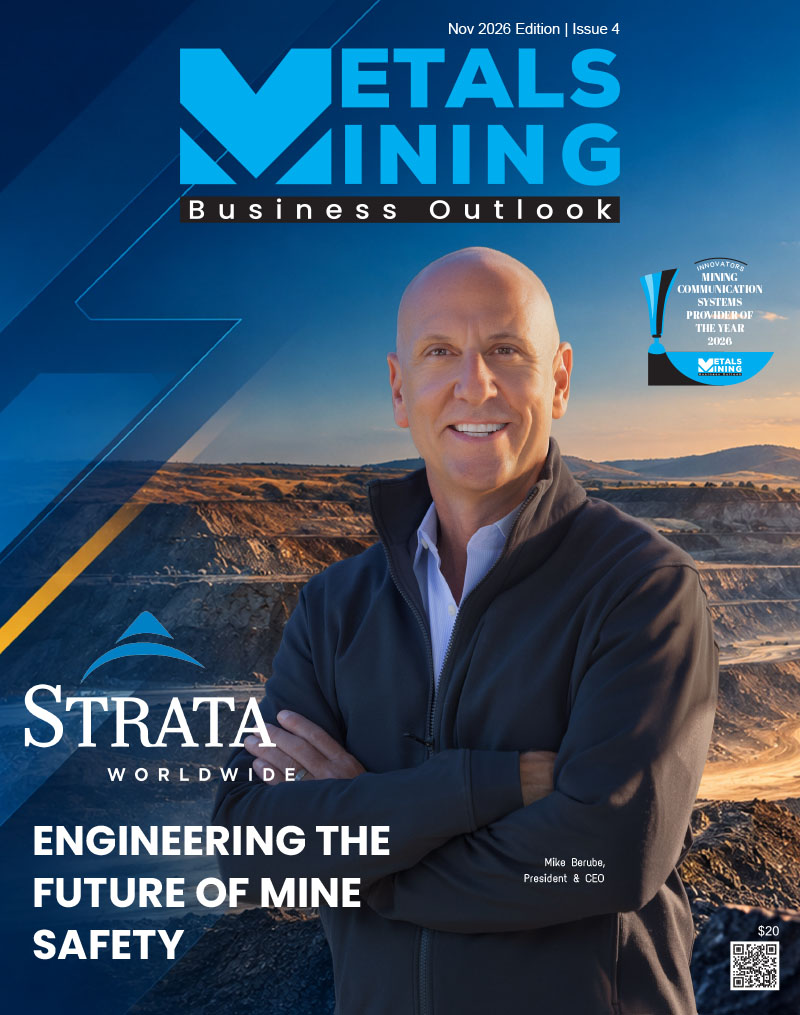
At Metals Mining Business Outlook Magazine, we recognize the critical role that the metals and mining industry plays in the global economy. From exploration and extraction to processing and sustainability, our content covers every facet of the industry.
We respect your privacy. The email address you provide will be used solely for subscription purposes and will not be stored or shared.
Subscribe Now
